When Plants Have Emotions
"....everything, now, has a different meaning."

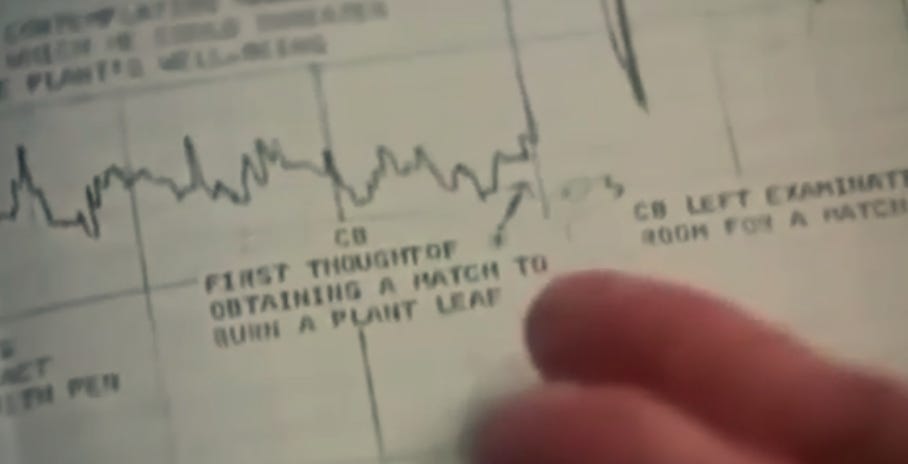
Cleve Backster was both a workaholic and a perfectionist. It’s no wonder that he was considered the world’s top expert on using polygraph machines for what is commonly referred to as “lie detection.” Law enforcement agencies across the US depended on the Backster School of Lie Detection, housed in a nondescript building in San Diego, for training in this important aspect of their work. Pulling all-nighters was not unusual for him; he was not only in demand as an instructor, but also as a consultant and speaker. In addition to managing the logistics of running his business, he often spent additional time poring over research and data from his reports. He was driven.
Backster greeted a rising California sun after one such all-night work binge on the morning of February 2, 1966. At one point, rising from his chair to give his office plants some water, it occurred to him that an electrode placed on a leaf might reveal information about a plant as well. After all, plants contain water just as the human body, an excellent conductor of electricity, the basis of polygraph technique.
He attached an electrode to a philodendron leaf and powered the machine to which it was attached. The scratchy-sounding pen began moving about in recognition of the plant’s input, then slowed its movement as it returned to a baseline level of activity. Backster had seen that many times; a human subject also causes an initial ‘blip’ when first connected, followed by a period of relative calm, allowing the examiner to determine that subject’s normal skin conductivity level.
How does one threaten a plant? He began by tearing a leaf on the plant, which drew hardly any response. Hmmm. Not one to give up easily, Backster considered different ideas, but finally thought of fire. I’ll get some matches and burn the leaf.
The polygraph’s mechanical arm began jumping wildly. Backster had only thought of burning the leaf; he hadn’t even had time to start moving toward the desk containing the matches.
The plant read his mind and responded emotionally.
Astounded at this outcome, Backster pushed further. If the plant is somehow aware of my intention, what else is it aware of? Moving to another plant, he held a match under one of its leaves, singing its delicate underside. The plant connected to the polygraph screamed in response, scattering ink across the scrolling page.
Backster would spend many more nights in his lab, meticulously studying this phenomenon. Although not trained as a scientist, he conducted his research with the same fidelity to scientific method as would any other respectable science investigator. If plants can ‘read’ information at a distance, he thought, my own thoughts could alter the results. He designed equipment that would conduct research in his absence, removing any possibility of his presence skewing the research results. He created another experiment in which a timer-controlled arm dumped a small cup of live brine shrimp into boiling water. He attached a random-number generator (RNG) to the timer controlling the arm so he wouldn’t even know at what point the dump occurred. He walked the nearby neighborhood while the RNG, timer, and other equipment did their work. Upon returning, he viewed another printout heavy with black ink. The philodendron was horrified at the sudden, violent death of about 50 shrimp.
Backster would later comment in an interview, “Now I look around and everything has a different meaning. It means that even on the lower levels of life, there’s a profound consciousness, or, an awareness that binds all things together.”
Although ridiculed by many at the time, Backster continued his nighttime experiments, demonstrating a similar effect in paramecium, mold, and blood cultures. Similar effects were obtained by other researchers over the years. Backster’s entire donated body of research is now housed at the University of West Georgia in Carrollton, and his early research into what scientists refer to as The Field now receives some much-due respect.
Every communication requires 1) a sender; 2) a receiver, and 3) a communication medium (think how air and water media conduct sound).
Like most research, Backster’s raises more questions than answers;
What is the communication medium?
How widespread is this phenomenon?
Does physical distance affect the phenomenon?
Could the communication be two-way?
You can meet Cleve Backster via a YouTube clip from a documentary on his work:
What are your thoughts? The comments are open!