Learning and Growing in Exile
The second post in a series.


In my previous article, we examined the notion of exile—if you haven’t read it, please do so before continuing here. It will make this article much more meaningful. :-)
I used the word exile to describe an unexpected, forced disconnection from something—it could be a job, relationship, community, religious organization, or a role.
Separateness is the very definition of exile, and importantly, exile is also associated with punishment. The uneasiness can cause you to doubt yourself, second-guess your choices, and even freeze in place. It’s hurtful and disorienting.
I believe there’s hope and help for those of us in this unfamiliar country. This is not just my wishful thinking, it’s an idea backed by psychology research.
And Viktor Frankl.
Weird Science
When most of us feel uncomfortable emotions, we’ll do anything to avoid feeling it—maybe just ignore it. Maybe have a drink. Or a smoke. Or go shopping. Engage in risky behaviors. Gamble. Anything to distract.
Avoiding uncomfortable emotions is counterintuitive to what scientific research indicates is most beneficial.
In 2007, researchers Neharika Chalwa and Brian Ostifin published a paper in the Journal of Clinical Psychology, reviewing 28 previous papers on the topic of Experiential Avoidance (EA). They found that EA—the tendency to ignore, suppress, or attempt to control painful emotions—is a significant contributor to psychopathology. Avoiding ‘negative emotions,’ they found, was closely associated with substance abuse and severity of PTSD symptoms.
Three years later, Martine Fleddurus and his team published a second, corroborating study. In the authors’ own words—
“….a person who is prone to use EA or has learned EA in stressful situations has a higher risk of developing psychopathology and lower mental health.”
The corollary? Willingness to experience uncomfortable emotions is one indicator of mental health.
That’s a tough pill to swallow, isn’t it? How can we be willing to sit inside discomfort while in exile? Why should we?
Viktor Frankl discovered the answers in a very personal way.
The Man
Victor Frankl was a psychiatrist and writer who lived in the mid-20th century. Frankl developed a practice he called logotherapy, a therapeutic approach designed to help people find meaning in adversity. His aim was to help others grow resilience and navigate hard times by staying true to their values and choosing their attitude toward suffering.
His life was his laboratory.
Frankl, an Austrian Jew, was arrested in 1942 by Hitler’s Third Reich. He, his wife, and parents were deported to concentration camps—he spent over two and half years in these camps, during which time most of his family would be killed. During this prison hell, Frankl noticed those prisoners who found some sense of meaning to their suffering tended toward greater psychological resilience. He returned to Vienna after the war to continue his work, and wrote Man’s Search for Meaning, one of the most influential books of the 20th century. He spent the balance of his life teaching and lecturing worldwide.
The theme of Frankl’s book surrounded that of choice. Even when personal freedoms, comforts, and even dignity are stripped away from us, Frankl said, we always retain capacity to choose our attitudes toward our current circumstances. He believed meaning is among our deepest psychological needs. Deeper than comfort, deeper than pleasure. Even in life’s darkest moments, we can find meaningful insight that can carry us through to brighter days.
Here’s one way to uncover meaning behind some common ‘negative’ emotions.
The Technique
My last post contained a suggested four-step cycle for navigating exile—below is Step #2:
Be curious rather than self-judgemental. Seek the information within your emotions, rather than avoiding those uncomfortable feelings. Consider what your natural intuition is telling you.
After some reflection, I thought Gosh, that ‘seeking emotional information’ bit sounds vague. Too arcane, too mysterious.
Here’s some more specific guidance. Let’s examine how to obtain emotional information by using Thought Themes.
Thought Themes
Extracting information from emotions is a fundamental skill in Emotional Competence (EC). Using emotional information allows to you to blend that data with cognition (thoughts), resulting in a more balanced approach to everyday living, better-informed choices, and healthier outcomes.
Your emotions are there to inform you, to contribute useful information as you navigate life’s up and downs. This is true about all emotions—joy, sadness, guilt, excitement, pensiveness….any emotion you can identify.
To glean your emotions’ wisdom, you have to do three things:
notice it
identify the emotion accurately
link the emotion with a Thought Theme
Let’s focus today on Step 3.
In my book, Cascade, I describe how Events trigger Thoughts, which are linked to the Emotions that drive our Behaviors. Here’s a visual:
Event—>Thought—>Emotion—>Behavior
Within the fog of exile, clarity can be elusive, but we can distill personal truth from the Thought behind an Emotion we’re feeling. Working backward within the cascade throws light on the ground we’re standing on.
Let’s look at some common feelings/emotions and Thought Themes that can trigger them.
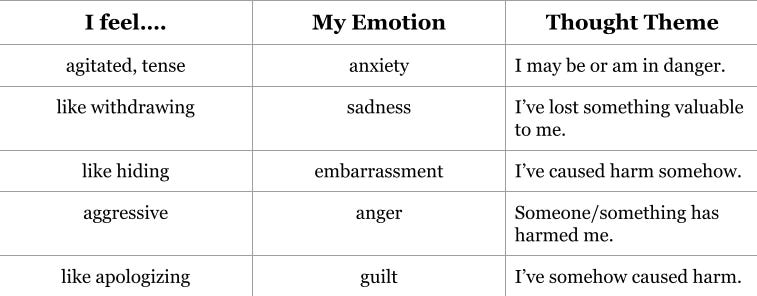
This table is provided to illustrate concepts and is not intended to be exhaustive. Also, know these associations are not static—for example, you may feel like withdrawing for reasons other than sadness.
Lastly, what we think of as ‘positive’ emotions have their own Thought Themes as well. What would be the associated feeling or behavioral tendency for the emotion of exuberance? Or compassion? Pride? Just for fun, grab a pencil and paper sometime and construct your own table for those! Could any of those have downsides? Hmmmm….
So, let’s be clear. Even if I realize ‘I’ve lost something valuable to me’, it doesn’t bring that thing back. It doesn’t reverse time. You might think that doesn’t solve the problem, so why should I bother doing this?
Because identifying a Thought Theme brings reality up close. You’re unable to sweep unpleasant feelings/emotions (and the thoughts that triggered them) under the proverbial rug. Because ignoring your distressful emotions and the thoughts behind them is a direct path to dysfunction (review the Weird Science section above as needed).
Ignoring your distressful emotions and the thoughts behind them is a direct path to dysfunction.
Using Thought Themes is a great way to clear the fog. And once it clears, the path forward is more likely to appear after doing this work.
You’ll be less likely to stay in unhelpful behavioral states, more likely to see ways forward.
Less likely to overthink, more likely to see alternatives.
Less likely to freeze, more likely to take goal-directed action.
Less likely to panic, more likely to respond rather than react.
You are more than you think you are. Here’s the same thought spoken differently…by Victor Frankl himself.
You are the airplane.